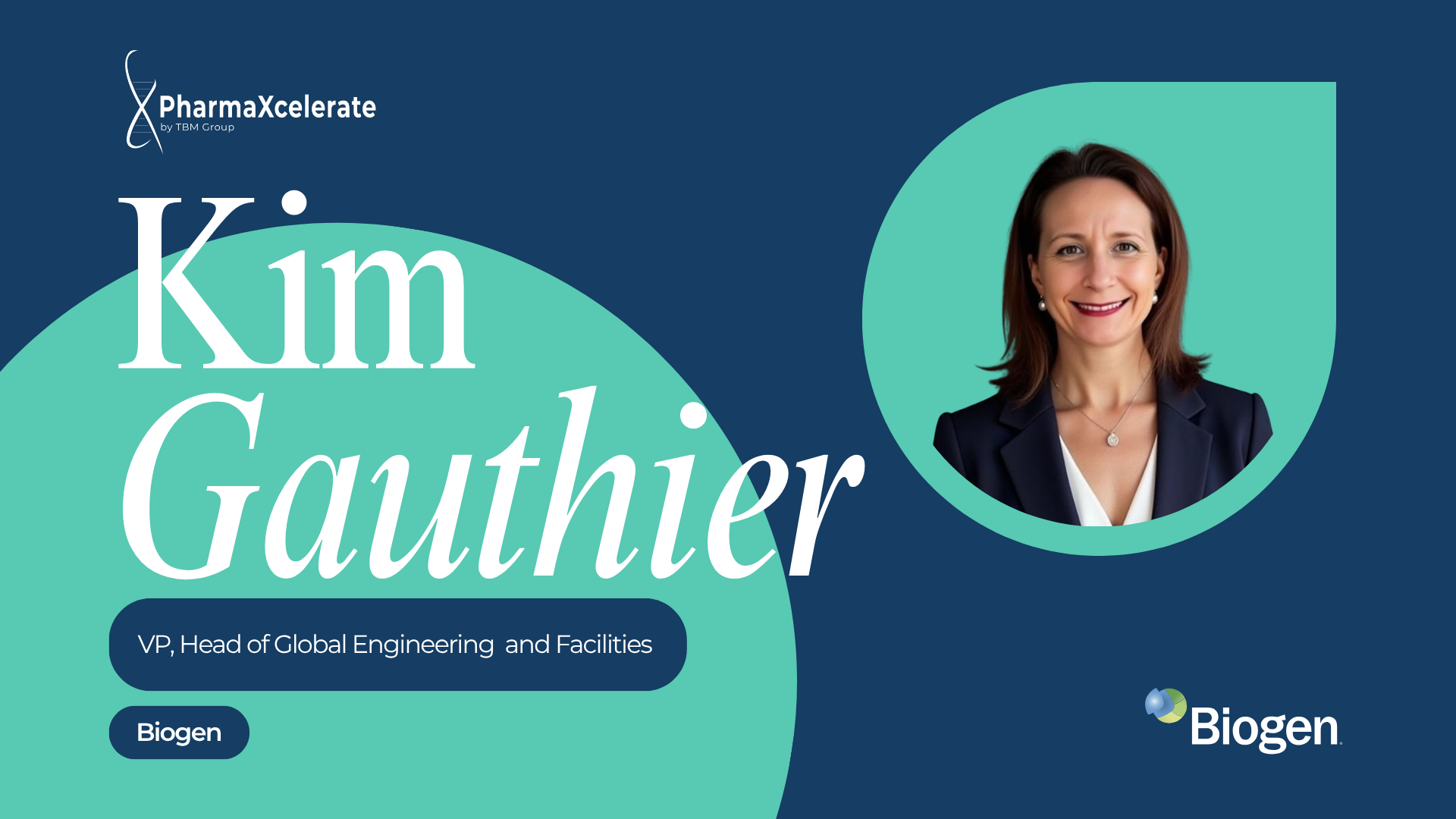
Engineering the Future of Biopharma: A Conversation with Kim Gauthier on Innovation, Sustainability and Next-Generation Manufacturing
July 1, 2026
"What I’ve learned designing and operating facilities across different manufacturing environments is that there is no one-size-fits-all solution. Each modality brings its own unique technical, regulatory, and operational challenges that need to be considered early in the design."
Introduction
KG: I’m Kim Gauthier, Head of Global Engineering and Facilities at Biogen
PX: What are you most looking forward to at the PharmaXcelerate USA conference this September?
KG: I’m most looking forward to gaining benchmarking data on how my peers are scaling complex therapies, especially what tools and techniques they are using to make drive new therapies to market faster.
Interview Questions
PX: The industry is moving rapidly toward multi-modality manufacturing. What is driving this shift and how is it changing facility strategy?
KG: Pipelines now include multiple modalities – from mABs, cell and gene therapies, mRNA, anti-body drug conjugates, oligonucleotides, and other peptides. The traditional one facility per modality is slow and capital intensive, and a lot of these modalities will be low-volume demand. That means it’s faster and more capital efficient to have highly flexible, multi-modality facilities. Additionally, with the expansion of single use systems, modular cleanroom pods, and highly digitized manufacturing, cross contamination risk is lowered allowing for co-location of molecules. These new modalities also bring high potent compounds and a greater need for robust containment control and segregation strategies, especially around HVAC systems and material storage. Facilities are shifting from fixed low potency, high volume designs to flexible high potency, low volume designs.
PX: How are facility requirements changing as companies expand into cell and gene therapies, mRNA, biologics, and other advanced modalities?
KG: Two of the biggest changes that are happening is the size of the equipment (and therefore the facility) and the flexibility of the facility. New facilities are being designed with modular ballrooms where containment and segregation strategies are driving the design. HVAC systems, hazardous raw material storage, and waste segregation become key to ensure the facility is efficient across modalities. In the past, facilities focused on the process design. Today with the amount of single use equipment and the size required for these new modalities the process becomes secondary to the facility. If a facility can mange low and high potency molecules, has sufficient hazardous waste storage, and can meet local wastewater treatment requirements either through segregation or robust onsite waste recovery/treatment, then the facility will be able to keep pace with the ever-expanding modalities that are continuing to emerge.
PX: What lessons have I learned from designing and operating facilities across different manufacturing environments?
KG: What I’ve learned designing and operating facilities across different manufacturing environments is that there is no one-size-fits-all solution. Each modality brings its own unique technical, regulatory, and operational challenges that need to be considered early in the design.
The key is to bundle processes strategically based on similarities—whether that’s environmental requirements, process flows, or support infrastructure—while also balancing how easily the space can be made flexible for future needs. Designing for adaptability is critical, but it requires thoughtful trade-offs upfront.
Two areas that consistently shape facility design are waste treatment and HVAC systems. Waste streams vary significantly by modality and must be addressed holistically to ensure compliance, safety, and operational efficiency. At the same time, HVAC configuration often becomes a primary driver of the overall facility layout, influencing zoning, segregation strategy, and even building massing. Ultimately, successful facility design is about aligning modality-specific needs with scalable, flexible infrastructure, while anticipating the constraints that systems like HVAC and waste treatment introduce.
PX: How do you ensure engineering teams remain aligned with manufacturing and quality objectives throughout facility projects?
KG: Manufacturing, quality, as well as safety, have a seat at the table throughout facility design and construction projects. They are part of the core team that set the user requirements for the facility. They participate in all major design reviews, ensuring the project is meeting their objectives.
PX: How are sustainability requirements influencing engineering and facility design decisions?
KG: Sustainability requirements are increasingly driven by company commitments around emissions reduction, energy efficiency, water use, and waste minimization, but must be balanced against cost constraints and location-specific factors. What’s feasible varies by region based on infrastructure, climate, and access to renewables, requiring site-specific solutions that still align with enterprise-wide goals. At the same time, both macro and micro government expectations are shaping design — global regulations are pushing decarbonization and electrification, while local requirements influence energy performance, wastewater, and building standards. As a result, facilities are evolving toward greater electrification, renewable integration, more efficient HVAC and utilities, and more deliberate materials and waste strategies — often improving both sustainability and operational efficiency.
PX: How are data integration and connectivity changing the way facilities operate?
KG: Data integration and connectivity are transforming facilities into fully connected, intelligent ecosystems where equipment, utilities, and manufacturing systems all generate and leverage real-time data. Looking ahead, connectivity and AI will be foundational and must be built in from the beginning, as retrofitting later is costly and limits the value of advanced analytics and automation. This shift is influencing both the resource model and facility design, enabling more centralized or remote operations while increasing demand for digital and automation expertise. It’s also reshaping layout and space planning, with greater focus on control rooms, data hubs, and infrastructure that supports connectivity. Ultimately, the goal is to create highly connected, data-enabled facilities that can optimize performance in real time and scale into future AI-driven operations.
PX: How do you build engineering organizations capable of supporting rapid growth and transformation?
KG: Building an organization that can scale and transform starts with intentionally designing for agility — both in structure and mindset. I focus on creating a highly adaptable workforce, where teams are cross-functional, empowered to make decisions, and able to pivot quickly as priorities evolve. A key element is empowerment and ownership. I encourage teams to proactively identify opportunities to improve how we operate through process innovation, new tools, or emerging technologies. This means creating an environment where experimentation is supported and failure is treated as a learning mechanism, not a setback. Sustaining growth requires a strong culture of continuous improvement and innovation. I reinforce this by setting clear expectations that innovation is part of everyone’s role, aligning incentives to outcomes, and ensuring we stay externally aware of industry advancements so we can adopt and scale new technologies effectively.
PX: What emerging technologies do you believe will have the greatest impact on engineering and manufacturing operations?
KG: The biggest impact is coming from advancements in the digital and sustainability spaces. On the digital side, technologies like AI, digital twins, and connected data systems are enabling more predictive, integrated, and autonomous operations. At the same time, sustainability-driven technologies such as energy optimization, electrification, and smart utilities are transforming how facilities are designed and operated to reduce environmental impact while improving efficiency. Ultimately, the future is a digitally mature facility. One that leverages real-time data and advanced analytics to drive performance while keeping costs low and sustainability high.