Waiting for Perfect Certainty May Be the Biggest Risk Facing Pharma Today - An interview with Gisèle Fahmi, Director, Internal Manufacturing Operations Quality (IMOQ) QC Digitization, Pfizer
June 4, 2026
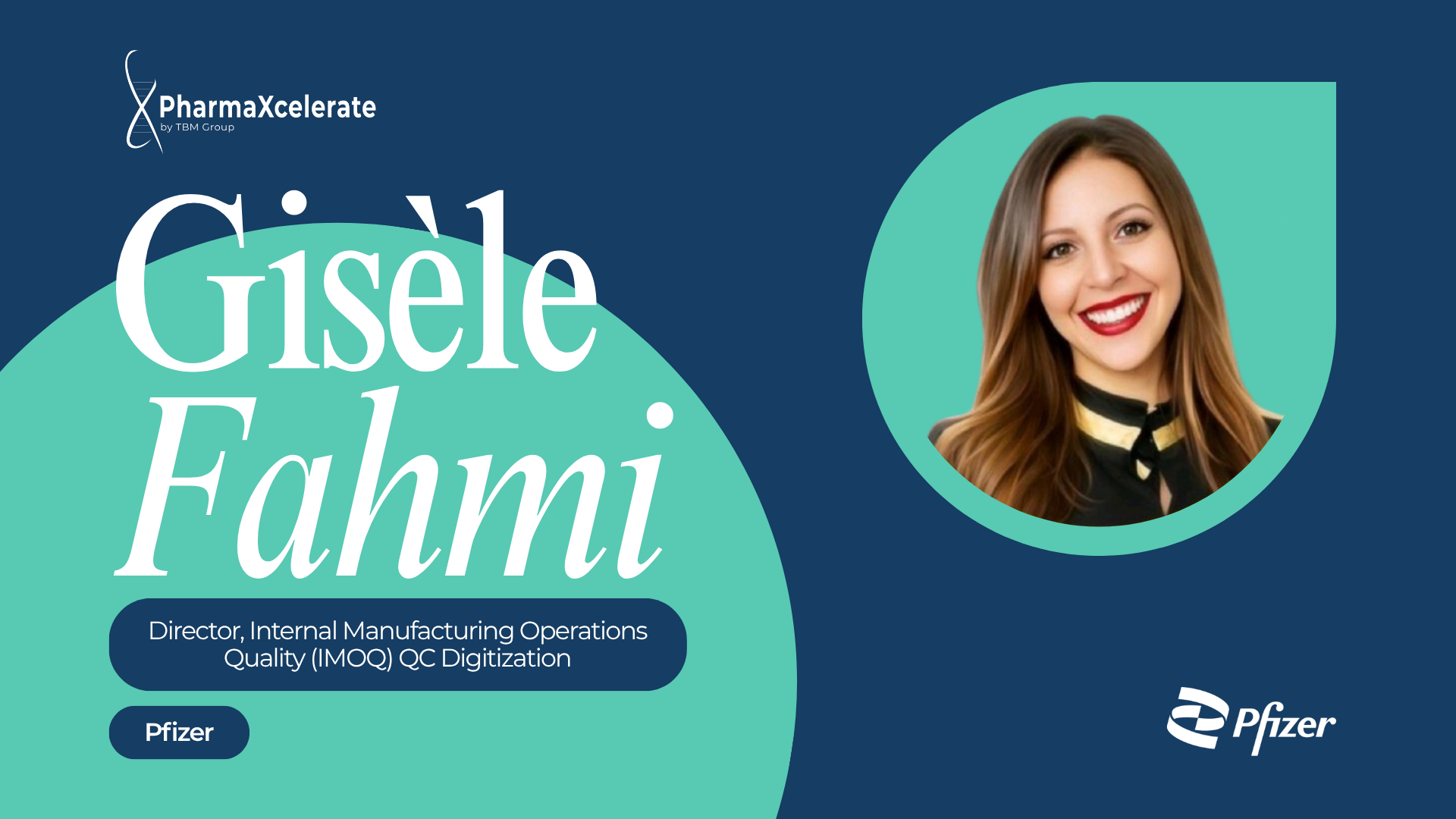
Artificial intelligence is no longer a future conversation for life sciences. In this exclusive PharmaXcelerate USA 2026 interview, Gisèle Fahmi explores how organizations can accelerate AI adoption, modernize compliance, build trusted data ecosystems and prepare their workforce for the next era of pharmaceutical manufacturing and quality operations.
Waiting for Perfect Certainty May Be the Biggest Risk Facing Pharma Today - An interview with Gisèle Fahmi, Director, Internal Manufacturing Operations Quality (IMOQ) QC Digitization, Pfizer
My name is Gisèle Fahmi, and I lead the QC Digitization team within Internal Manufacturing Operations Quality at Pfizer.
What excites me most about the PharmaXcelerate conference this September is the opportunity to connect with industry leaders who are driving the future of life sciences through digital transformation, AI, and innovation. I’m especially looking forward to exchanging perspectives on how we can accelerate innovation responsibly while continuing to strengthen quality, compliance, and patient impact across the industry.
PX: Your career spans quality, regulatory affairs, digital manufacturing, AI governance and strategic transformation. What originally drew you toward this intersection of technology and life sciences?
Gisèle: What originally drew me to this intersection was a very personal desire to contribute to an industry that directly impacts and sustains lives.
After completing my Master’s degree in Biomedical Engineering, I intentionally started my career on the manufacturing floor as an automation and validation engineer because I wanted to understand pharmaceutical operations from the ground up — as close to the product and patient impact as possible.
That early experience taught me some of the most important lessons of my career: operating with urgency, making critical decisions with imperfect data, and balancing innovation with risk management in highly regulated environments.
As I worked with manufacturing systems and automation platforms like Rockwell Automation and batch management systems, I became increasingly fascinated not only by the operational side, but by the digital infrastructure behind it. That curiosity led me into IT, compliance, and quality systems, where I wanted to deeply understand the regulatory foundations that enable us to deliver safe, compliant, high-quality products to patients.
One of the most formative experiences in my career was working at Schering-Plough during the consent decree period. It gave me firsthand exposure to regulatory rigor, audit readiness, and the discipline required to operate in highly scrutinized environments.
Over time, I expanded across supply chain, PMO, quality management systems, digital manufacturing, and transformation leadership. What continues to inspire me is that life sciences is one of the few industries where technology, compliance, innovation, and human impact are all deeply interconnected. It is an ecosystem that never stops evolving — and neither do I.
PX: What did you learn about the readiness of pharma organizations for AI adoption during your current role leading Global Digital Manufacturing and Transformation at Pfizer?
Gisèle: One of the biggest observations I’ve made is that the pharmaceutical industry historically lagged behind other industries in digital adoption. Many organizations were still heavily reliant on paper-based processes for validation, change controls, and quality documentation long after digital capabilities existed.
However, the emergence of AI significantly accelerated the pace of transformation.
What’s fascinating is that while digital transformation initiatives often faced resistance in the past, AI adoption has moved much faster because employees are already experiencing immediate productivity value in their day-to-day work.
Today, even in organizations or manufacturing sites that still have legacy paper-based processes, employees are actively using AI tools to support content generation, data analysis, documentation, and decision-making. That shift is extremely encouraging.
At the same time, readiness is not only about technology — it’s about mindset and culture. One of the biggest challenges remains the fear that AI will replace human expertise. I see AI very differently. I see it as an augmentation capability that enables us to operate more strategically and efficiently.
Personally, I use AI extensively as a thought partner, productivity accelerator, and leadership development tool. It allows me to move faster, focus on higher-value work, and create more capacity for innovation. In my view, organizations that succeed with AI will be the ones that position it as a human-enablement strategy rather than a replacement strategy.
PX: You’ve led large-scale digital transformation programs across global manufacturing networks. What has been the biggest leadership lesson from managing change at scale?
Gisèle: The biggest leadership lesson I’ve learned from managing transformation at scale is that successful transformation is ultimately about people, not technology.
Technology implementation is often the easier part. Building trust, alignment, resilience, and adaptability across global teams is the real challenge.
I’ve learned the importance of building strong, high-performing teams that operate with transparency, accountability, and psychological safety. When organizations undergo large-scale change, uncertainty naturally creates resistance. Leaders have to create clarity, communicate vision consistently, and empower teams to become part of the transformation rather than feel impacted by it.
I also learned the importance of agility and contingency planning. In global transformation programs, things rarely go exactly as planned. Having a strong Plan B — and sometimes even a Plan C — is critical.
The most effective leaders are the ones who can remain calm under pressure, adapt quickly, and continue moving the organization forward while maintaining team confidence and engagement.
PX: How can pharma companies accelerate AI innovation while maintaining regulatory-grade compliance? Do you believe the industry is moving fast enough to establish governance frameworks for AI?
Gisèle: I believe AI innovation is currently moving significantly faster than governance and compliance frameworks — and that creates both opportunity and risk for the industry.
Historically, compliance organizations have often been reactive during major technology shifts. We saw this during earlier phases of digitization, where compliance adoption frequently lagged behind operational innovation. With AI, we cannot afford for governance to remain behind the curve.
Organizations need to proactively modernize compliance capabilities by investing in AI literacy, agile governance models, digital risk management, and cross-functional collaboration between business, quality, compliance, and technology teams.
Most importantly, compliance cannot be viewed as a separate department that slows innovation. In high-performing organizations, quality and compliance become embedded cultural responsibilities shared by every employee.
When that mindset exists, governance becomes an accelerator rather than a barrier.
I also believe compliance professionals themselves must evolve. Future-ready compliance teams will need to become more technologically fluent, data-driven, agile, and comfortable operating in rapidly evolving digital environments.
The organizations that will lead the industry are the ones that successfully integrate innovation and compliance together — rather than treating them as competing priorities.
PX: What capabilities must organizations build now to remain competitive?
Gisèle: The organizations that will remain competitive over the next decade will be the ones that successfully combine AI capabilities, strong data foundations, and workforce transformation.
AI agents and intelligent automation will increasingly support routine operational activities such as document generation, review workflows, deviation reporting, standardization, and knowledge management across global sites.
But AI is only as powerful as the data behind it.
That’s why building centralized, trusted, high-quality data ecosystems is absolutely critical. Organizations need strong data governance, reliable source-of-truth systems, and meaningful structured data that can power scalable AI solutions.
Beyond technology, companies also need to invest heavily in digital capability building across their workforce. The future competitive advantage will come from organizations that can combine human expertise with AI-enabled decision-making at scale.
The possibilities are expanding rapidly — and in many ways, we are only at the beginning of what AI can unlock for pharmaceutical operations and patient outcomes.
PX: What trends are you currently seeing in partnerships between pharma and technology companies?
Gisèle: One of the biggest trends I’m seeing is the evolution of technology vendors into long-term strategic transformation partners rather than traditional service providers.
Pharmaceutical companies are increasingly recognizing that innovation cycles are moving too quickly for organizations to operate in isolation. Strategic partnerships with technology companies allow us to accelerate modernization while leveraging highly specialized expertise.
For example, during my time leading the global records management organization, we partnered closely with Kneat Solutions to transform our operational strategy and digital enablement approach.
That partnership helped us achieve measurable business impact, including approximately 50% faster deployments, 45% cost reductions, and significant improvements in user enablement and adoption.
These types of collaborations demonstrate how strategic partnerships can drive both operational efficiency and business transformation at scale.
Going forward, I believe the strongest pharma organizations will be the ones that build highly collaborative ecosystems across technology providers, AI companies, regulators, and internal business functions - all with the shared goal of accelerating innovation while continuing to protect patient safety and product quality.