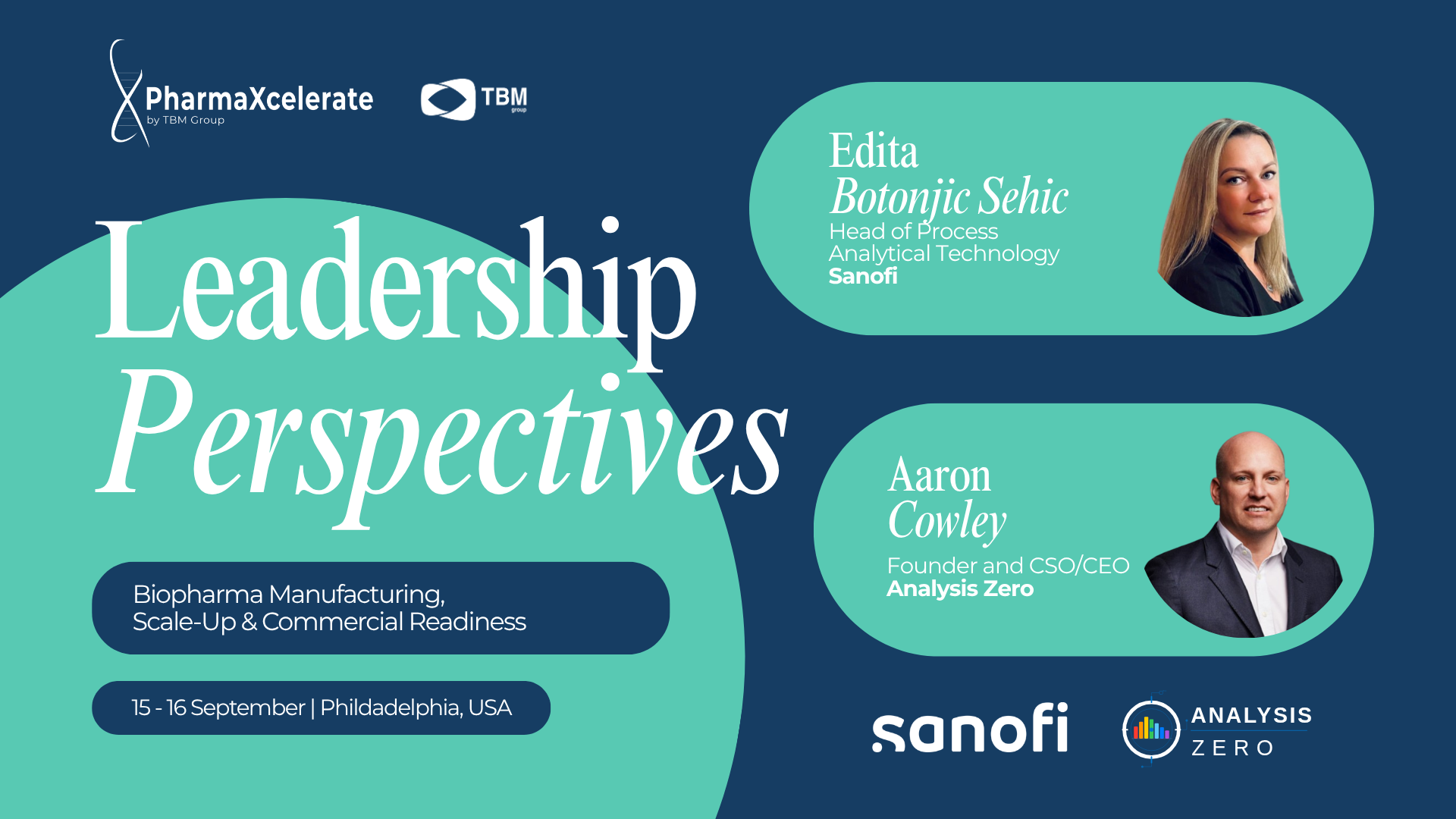
Leadership Perspectives with Edita and Aaron
June 13, 2026
“The industry is actively transforming manufacturing through connected PAT ecosystems - where AI, digital twins, and predictive analytics are enabling real-time process understanding and improved product quality.”
Introduction
Hello, I’m Edita Botonjic-Sehic, Head of Process Analytical Technology at Sanofi and I am Aaron Cowley, Founder and CSO/CEO at Analysis Zero.
Our work is focused on advanced modern biopharmaceutical manufacturing through integrated analytics, PAT orchestration and digital transformation strategies that enable smarter, data-driven decision-making across the manufacturing lifecycle.
What are you most looking forward to discussing with fellow industry leaders at the PharmaXcelerate USA panel this September?
What we are most looking forward to at the PharmaXcelerate USA panel is discussing how the industry is actively transforming manufacturing through connected PAT ecosystems — where AI, digital twins, and predictive analytics are enabling real-time process understanding, accelerated decision-making, and improved product quality in regulated biopharmaceutical manufacturing.
PX: Which of these tools do you believe are still underutilized in the industry today?
Edita: Many process analytical technologies remain significantly underutilized across the industry, although several modalities are gaining momentum. Inline and online NMR, MALS, Raman spectroscopy continue to demonstrate strong value, particularly when integrated within a unified PAT framework.
Combining these technologies through an orchestrated platform enables real-time process insight, enhanced control of critical quality attributes, accelerated decision-making, and stronger foundation for scalable and regulatory-ready manufacturing.
All these techniques have tremendous potential for real-time, non-destructive monitoring of critical quality attributes in complex biologics and advanced therapies, yet many organizations still rely heavily on offline testing. Similarly, MVDA often remains a retrospective data analysis tool rather than being used proactively for predictive control and process optimization.
The real opportunity is not simply deploying individual technologies, but orchestrating them together — connecting light scattering techniques, spectroscopy, process sensors, automation systems, and contextual manufacturing data into a unified decision-making environment.
Aaron: While deploying analytical tools and automating them is one part of the process, there remains regulatory approval for its use in production. At the same time, broader implementation continues to face regulatory hurdles, particularly around validation and approval of real-time PAT methods for GMP production environments.
One effective pathway to accelerate adoption is the development of standardized regulatory strategies, including regulatory submissions for PAT methods and analytical models. Establishing PAT methods within a regulatory framework can provide regulators with a structured approach to review validation data, model performance, lifecycle management, and comparability, ultimately helping companies gain confidence and regulatory acceptance for real-time release and advanced process control strategies.
The industry will benefit from clearer regulatory pathways, standardized validation approaches, and broader use of regulatory pathway to support approval and deployment of PAT-driven manufacturing systems.
PX: How are you approaching the integration of PAT tools across different modalities such as mAbs, gene therapies, and mRNA platforms?
Aaron: Our approach is centered on platform flexibility and digital interoperability. Each modality — monoclonal antibodies, gene therapies, and mRNA — has unique process dynamics, but the underlying need for real-time process understanding is consistent across all of them.
We focus on creating scalable PAT architectures where analytical tools, automation systems, and data platforms can communicate seamlessly. That includes integrating spectroscopy, flow-based analytics, soft sensors, and advanced modeling into workflows that support both development and GMP manufacturing.
A major focus is also enabling digital twins and predictive models that allow teams to simulate process behavior, identify deviations earlier, and accelerate tech transfer across sites and modalities.
Edita: Emphasizing digital twin development and model lifecycle management so that process understanding can evolve continuously throughout development and manufacturing is extremely important. By integrating PAT tools with automation systems and manufacturing execution environments, we can support real-time monitoring of critical quality attributes, faster deviation detection, and ultimately real-time release strategies.
Aaron: A major part of the strategy is ensuring regulatory readiness from the beginning. Rather than treating validation as a late-stage activity, we incorporate model validation, data integrity, traceability, and lifecycle documentation directly into the PAT architecture. We also see regulatory pathway needs for PAT methods and models as an important mechanism for enabling broader regulatory acceptance and simplifying deployment across multiple manufacturing sites and products. We have come to realize that if we implement PAT tools in the QC laboratory (displacing standard QC assays/methods/instruments) it speeds adoption and acceptance.
Edita: Ultimately, the goal is to create an interoperable PAT infrastructure that reduces silos between process development, manufacturing, quality, and regulatory teams while enabling scalable and adaptive manufacturing across multiple therapeutic modalities.
PX: Which analytical technologies are currently having the biggest impact on smarter manufacturing environments?
Aaron: The biggest impact is coming from the convergence of inline analytics, AI-driven modeling, and digital infrastructure. Specifically, in-line Raman, NIR spectroscopy and digital PCR are the ones having largest impact/and highest adoption rate.
Edita: Technologies like Raman and NIR spectroscopy continue to advance because they provide real-time visibility into process conditions, while cloud-connected data architectures and MVDA platforms allow manufacturers to contextualize and operationalize that data more effectively.
At the same time, digital twins and machine learning are transforming how manufacturers approach process optimization and scale-up. Instead of reacting to failures after they occur, organizations are beginning to predict variability and intervene proactively.
The future of smart manufacturing is really about orchestration — connecting analytical insight with automation and operational decision-making.
PX: What are some real-world examples where integrated analytics have accelerated process understanding or improved product quality?
Edita: One strong example is the integration of Raman spectroscopy with multivariate models during upstream bioprocessing to monitor consumption of NTPs (nucleoside triphosphates) and making of product in IVT reaction as well as nutrient consumption and metabolite formation during fermentation in real time. This has enabled tighter process control and reduced batch variability.
Another area is advanced therapy manufacturing, where integrated inline and at-line analytics can significantly shorten release timelines by reducing dependency on delayed offline testing.
Aaron: We’re also seeing digital twin environments improve process understanding during scale-up and technology transfer by allowing teams to compare simulated versus actual manufacturing performance and identify sources of variability much earlier. I have seen firsthand a manufacturing process be reduced by 60% and the QC cost by 80% using integrated analytics, so I know what is possible.
PX: As manufacturing processes become increasingly digitalized, what new skills will scientists and engineers need to develop?
Edita: The next generation of scientists and engineers will need to be both scientifically strong and digitally fluent. Beyond core expertise in chemistry, biology, or engineering, there will be increasing demand for skills in data analytics, AI-assisted modeling, automation systems, and data contextualization.
Equally important is the ability to work cross-functionally — understanding how analytical data connects with manufacturing operations, quality systems, and regulatory expectations. Future teams will need to bridge the gap between R&D, manufacturing, QA, regulatory affairs, and business leadership to successfully deploy advanced manufacturing technologies at scale.
The industry is moving toward integrated, data-driven manufacturing ecosystems, so the professionals who can bridge science, digital technology, and operational strategy will have the greatest impact.
Aaron: There is also a growing need for stronger regulatory knowledge. Scientists and engineers must understand validation strategies, data integrity requirements, model lifecycle management, GMP expectations, and evolving FDA and global regulatory frameworks surrounding PAT, AI-driven analytics, and digital manufacturing. The ability to support regulatory submissions, comparability studies for analytical methods and models will become increasingly valuable as companies move toward real-time release and adaptive manufacturing.
In addition, business acumen will become just as important as technical expertise. Teams will need to understand cost of goods, manufacturing scalability, technology transfer, global deployment strategies, and return on investment for digital transformation initiatives. The future leaders in this space will be those who cannot only develop innovative technologies, but also clearly demonstrate their operational, regulatory, and commercial value across global manufacturing networks.
PX: What excites you most about the future of AI and advanced analytics in biopharma manufacturing?
Aaron: What excites me the most is the shift toward truly intelligent and adoptive manufacturing environments where AI, PAT and advanced analytics work together in real time to improve product quality, efficiency, and decision-making.
Edita: The ability to combine advanced analytics, predictive modeling, digital twins, and continuous monitoring will allow manufacturers to move from reactive operations to proactive process control and it cannot be achieved without integrated analytics.
This has the potential to accelerate scale-up, reduce batch failures, shorten release timelines, and ultimately bring therapies to patients faster with greater consistency and reliability.
PX: Which emerging technologies or trends do you believe will have the greatest impact on the next generation of biopharmaceutical production?
Edita: Greatest impact will come from the convergence of AI-driven process orchestration, digital twins, advanced PAT platforms, and connected manufacturing systems. Real-time analytics integrated with automation will enable continuous manufacturing and more autonomous operations. In addition, advances in PAT, machine learning, single-use technologies, and modular manufacturing will improve flexibility and scalability across biopharma facilities.
Aaron: The growing use of integrated data platforms that connect laboratory, process, and operational data will also transform how companies optimize processes, validate systems, and meet regulatory expectations. The implementation and use of AI should and will start to democratize equipment, raw materials and supplies which will dramatically shift the industries value chain.
The views, opinions, and statements expressed in this document are solely those of author and are based on the author’s personal professional experience and perspectives. They do not reflect the views, position, policies, or opinions of the author’s employer, affiliated organizations, clients, or partners.